
CALIBER MECHANICAL SYSTEMS
Two Systems. One Philosophy.
CALIBER develops two distinct guitar tuning-machine systems based on different mechanical transmission
principles: Roller Cam (RC) and Worm Gear (WG).
Explore the fundamental structures and operating principles behind these two approaches to transmitting and
controlling rotational motion.
3:4 세로형
01 — ROLLER CAM SYSTEM
Rolling-Contact Transmission
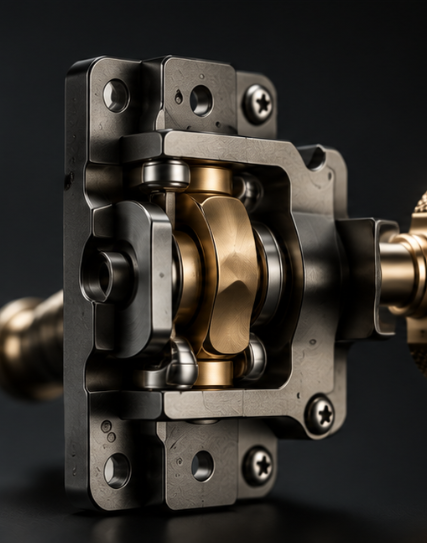
A roller-cam mechanism transmits motion through the engagement of a profiled cam and multiple rolling followers.
As the cam rotates, its contoured surface engages the followers in sequence, transferring motion to the driven component.
Unlike conventional worm gearing, which involves sliding tooth contact, the roller-cam principle utilizes rolling contact at the cam-follower interface.
This transmission principle is used in industrial precision motion-control and positioning applications.
02 — WORM GEAR SYSTEM
Sliding-Contact Transmission.
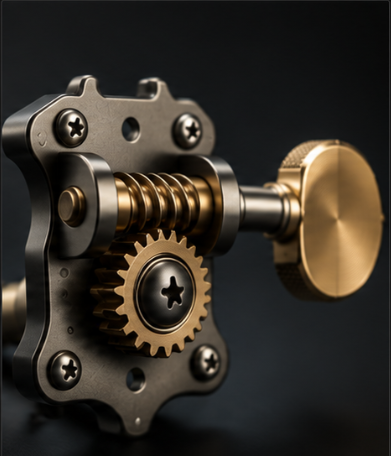
A worm-gear mechanism consists of a screw-like worm and a mating worm wheel, typically arranged on perpendicular, non-intersecting shaft axes.
As the worm rotates, its helical thread engages the teeth of the worm wheel, transmitting motion through sliding contact.
This arrangement enables substantial speed reduction within a compact mechanical transmission system.
Depending on its geometry, friction, and lubrication conditions, worm gearing may also provide resistance to reverse motion.
3:4 세로형
CALIBER ACOUSTIC SYSTEMS
Floating Truss Network.
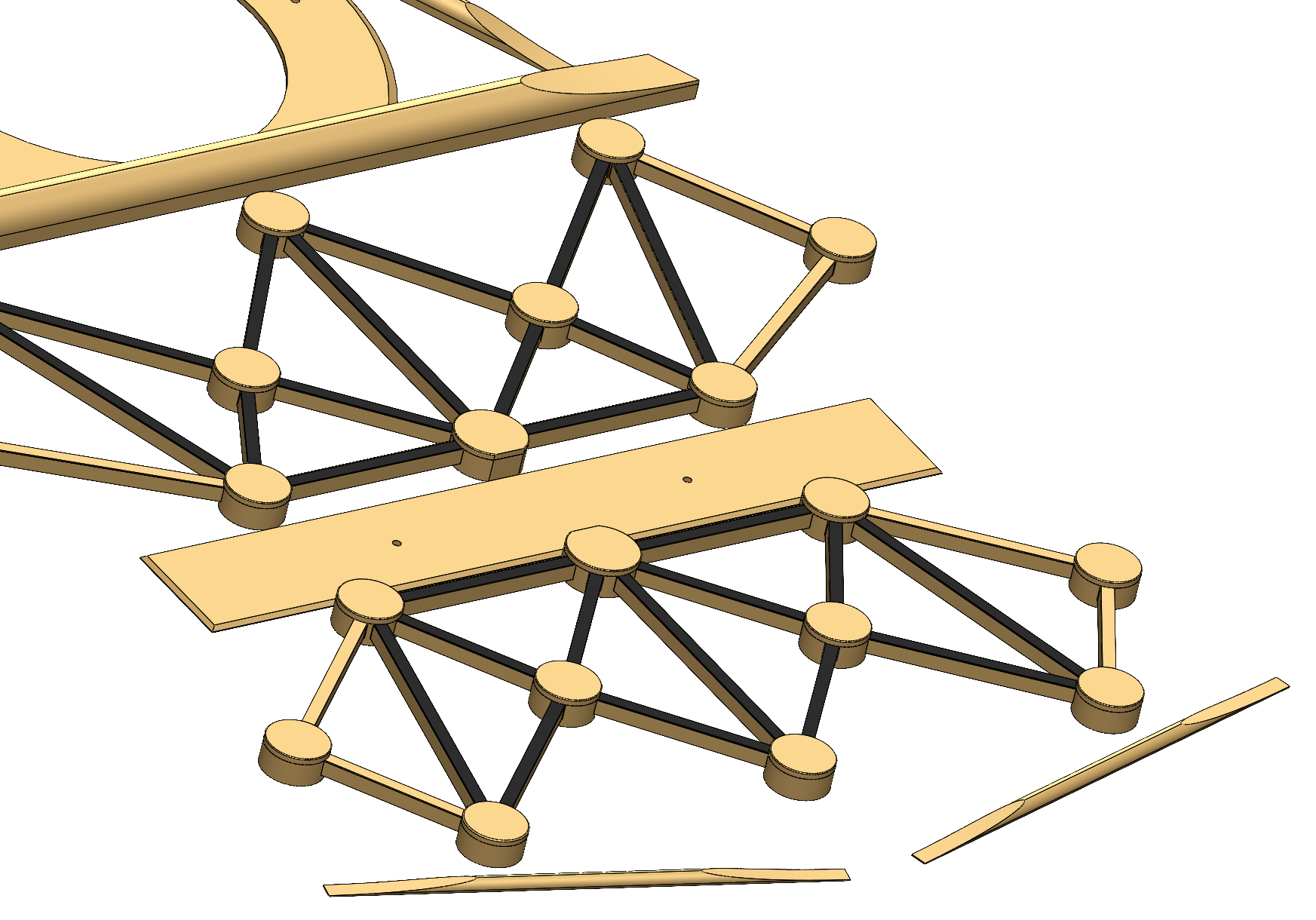
03 — GUITAR STRUCTURAL SYSTEM
A Different Approach to Soundboard Architecture.
The Floating Truss Network is an alternative structural concept for the classical guitar soundboard.
Unlike conventional bracing systems bonded directly along the soundboard, it employs an elevated network of interconnected structural members supported at selected attachment points.
The concept separates the network into regions positioned in front of and behind the bridge, introducing different approaches to load distribution within the soundboard structure.
Originally explored as the Floating Lattice in 2011, the concept evolved into the Floating Truss Network in 2026.
THE CALIBER APPROACH
Different Systems. One Philosophy.
From mechanical transmission to acoustic structure, CALIBER explores how purposeful engineering can serve the instrument and the musician.
Discover the design decisions that connect these distinct systems through a shared commitment to precision, function, and craftsmanship.